VCM-Photography
Welcome to VCM-Photography, a website designed and written
by myself Vernon Metcalfe to showcase my photographic passion for
military aviation and wildlife.
My aviation photography is orientated towards the dynamic aspect of military low flying,
where aircraft are captured flying landlocked against the countryside, rather than
airshow photography, where aircraft are captured against the sky.
My parallel passion is wildlife photography, encompassing all species, but with a preference
for the ‘Big Cats’, which has taken me to places such as India, looking for the
elusive tiger, Africa for the lion, leopard and cheetah and to the Brazilian Pantanal for the
iconic jaguar.
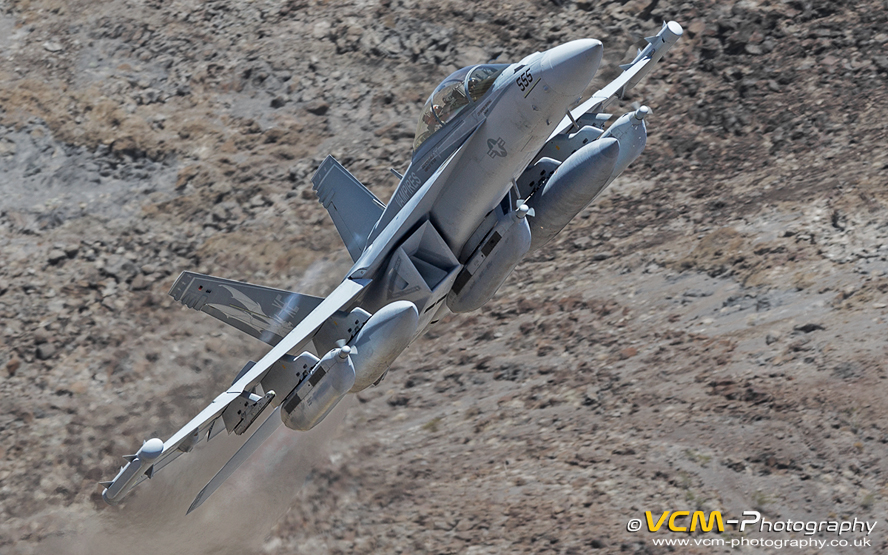 Boeing EA-18G Growler low-level in the Jedi Transition. California, U.S.A.
 Nkuhuma Pride, lion cub. Sabi Sands, South Africa.
Copyright Notice
All applicable copyright laws pertain to all content on this site. Downloading, hot‑linking, copying
and/or distribution (by print, electronic media or other means) is strictly prohibited.
If you wish to purchase high quality images, or use any images for personal or commercial use please
email: vcmetcalfe@btinternet.com
Trip report August 2025
The National Museum of the United States Air Force, located at Wright‑Patterson Air Force Base near Dayton, Ohio,
is regarded as the world's oldest and largest aviation museum. The museum has more than 360 aircraft and missiles on display.
In June 2016, the museum opened its 224,000 square‑foot fourth building that expanded the museum to its current 1,120,000
square feet of exhibit space. With the additional space, more than 70 aircraft that were in storage have been put back on display.
The museum has two iconic aircraft that have held me spellbound since my childhood, the North American X‑15 hypersonic
rocket‑powered aircraft and the North American XB‑71A Valkyrie.
The North American X‑15 rocket‑powered research aircraft was operated by NASA to expand its knowledge of flight
at speeds exceeding Mach 6 and at altitudes above 260,000ft. It gathered data on the aerodynamic and thermal performance of the
aircraft as it flew to the edge of space. It bridged the gap between manned flight within the atmosphere and manned flight beyond
the atmosphere into space. The data gathered from the three X‑15's built and 199 research flights directly influenced
the design of the Mercury and Gemini spacecraft, as well at later rocket programs.
The only fatality of the X‑15 program occurred on the 15th of November 1967, when X‑15‑3
(S/N 56‑6672) piloted by Major Michael J. Adams was launched from its B‑52B mothership ‘Balls 8’
over Delamar Dry lake on X‑15 flight 191 to conduct several experiments. Several minutes after launch the X‑15 experienced
an electrical disturbance which caused the aircraft to enter a hypersonic spin. Adams managed to recover from the spin, but the
aircraft started oscillating so violently that the airframe broke apart scattering wreckage over a wide area. The cockpit, with Adams
still inside crashed to the ground near the small California settlement of Johannesburg. At the crash site a memorial has been erected
to honour Michael J. Adams and his contribution to the U.S space program. I have visited the memorial a couple of times, and taking a
keen interest wanted to see at least one of the two remaining X‑15's which are exhibited in museums. In August/ September
2024, my wife and I visited Washington D.C. to see the city, but to also visit the Smithsonian Air & Space Museum where
X‑15‑1, S/N 56‑6670 is exhibited. Since 2018, the museum has been undergoing a large‑scale renovation and
when we visited not all the galleries had reopened, and typically one of them was where the X‑15 was displayed. So that was one
reason why I wanted to visit the museum at Dayton.
The North American XB‑70A Valkyrie originated from the USAF B‑70 program of the 1950's for the development of a
nuclear‑armed, deep‑penetration supersonic strategic bomber. Flying faster tham Mach 3 at an altitude of 70,000ft the
aircraft was expected to be practically immune to any interceptor aircraft. The program was eventually cancelled in 1961, due to the
introduction of Soviet surface‑to‑air missiles which put the near‑invulnerability of the aircraft in doubt, and
finally due to the introduction on intercontinental ballistic missiles (ICBM's) which saw the need for such a bomber as
obsolete. Development of the aircraft continued as a research tool to study the effects of long‑duration high‑speed flight.
Two aircraft were built: XB‑70A, S/N 62‑0001 and S/N 62‑0207. Between 1964 and 1969 they were used for
supersonic test flights. In June 1966, S/N 62‑0207 was lost due to a mid‑air collision with a F‑104N
Starfighter during a photoshoot for General Electric, the engine manufacturer. Both aircraft crashed in the Mud Hills, north of
Barstow, California. Joe Walker, the pilot of the Starfighter and Carl Cross, the co‑pilot of the Valkyrie were killed in the
accident. Al White, the Valkyrie pilot managed to eject safely. During a visit to California In May 2025, I tried to visit the
crash site memorial of the Valkyrie, but failed to find it.
(see Trip Report May 2025).
The remaining XB‑70A Valkyrie, S/N 62‑0001 took its last supersonic flight on 17th December 1968, and its final flight
on 4th February 1969 when it was delivered to the museum at Dayton. This was the second reason why I wanted to visit the museum at
Dayton.
Note: I have since returned to California and managed to find the crash site memorial for Valkyrie S/N 62‑0207 and pay
my respects to Major Carl cross
(see Trip Report May 2026). I still
have to visit the crash site memorial for the F‑104N Starfighter pilot, Joe Walker.
In August 2025, my wife and I planned a short holiday to America with the specific intention of visiting the National Museum of the
United States Air Force near Dayton, Ohio. Our itinerary for the trip was as follows:
‑ Saturday 23rd. Depart London Heathrow at 13:10 on a British Airways International flight to Chicago,
Illinois, where we had the Hilton Chicago O'Hare Airport hotel booked for the night.
‑ Sunday 24th. Domestic flight from Chicago to Dayton, where we would pick up a hire car at the airport and travel
into the city to our hotel for the next four nights, the Marriot at the University of Dayton.
‑ Monday 25th. Visit cultural attractions in and around Dayton.
‑ Tuesday 26th and Wednesday 27th. Visit the air museum. I calculated two days would be sufficient to comfortably
view and photograph all the exhibits at the museum.
‑ Thursday 28th. Have a relaxing morning, before catching an afternoon flight back to Chicago, where we had the
Hilton airport hotel booked again for the night.
‑ Friday 29th. Depart Chicago at 16:55 on a British Airways International flight back to London Heathrow.
As seems to be increasingly the norm of late with our travel plans, “The best laid plans of mice and men often go awry”.
Never a truer word spoken regarding this trip.
Our itinerary seemed to be going to plan, when our flight from London Heathrow to Chicago O'Hare departed on time. The aircraft
climbed to altitude and the flight attendants started serving the in‑flight meal as we coasted over Ireland into the
Atlantic Ocean. I looked out of my port‑side window which was above the main wing and saw that we were dumping fuel from a
nozzle located near the wingtip. How odd I thought. I didn't have time to dwell on the issue, as almost immediately the pilot
made an announcement that due to a technical issue which could not be rectified at Chicago we were dumping fuel as we had to return
to London Heathrow.
 Dumping fuel to lighten the aircraft for our landing back at London Heathrow.
When we arrived back at Heathrow, B.A. booked us into the London Heathrow Sofitel, and informed us that they had rescheduled us onto
a flight the next day. This really “Put the Cat amongst the Pigeons” regarding our travel plans. The evening was spent
trying to book new flights between Chicago and Dayton, amend the Hilton hotel reservation and contact Expedia regarding the hire
car. We managed to amend the Hilton airport hotel reservation and get new flights, but had to pay for them. Regarding Expedia,
whom the car was booked through, we had no such luck. I will never use them again. They are great if you want to make a booking, but
as with a lot of these companies as soon as you want to cancel or amend a booking you can never get through to a customer representative.
I must have been listening to telephone hold music for nearly an hour. In the end I gave up.
Sunday 24th ‑ Our British Airways flight departed London heathrow at 07:30 and found we had been upgraded to
Business Class, which was a nice surprise. From here the travel went OK till we arrived at Dayton International Airport on the
afternoon of Monday 25th, where we had reserved a hire car. Because we had not picked the car up the previous day, they had cancelled
our booking. I find this policy annoying. We had hired and pre‑paid for the car for the duration of our visit. Just because we were
late picking up the car should make no difference, as that car is hired out to us. Long story short, we had to make a new
booking and pay for it. This was turning out to be an expensive trip just to visit an air museum.
Tuesday 26th and Wednesday 27th ‑ Any sightseeing in and around Dayton had gone out the window as our trip was now running
a day behind schedule, leaving only two full days to visit the air museum. Once inside the museum, all the trauma of getting there was
soon forgotten. The museum has a vast collection of aircraft displayed in an Air Park and four hanger‑type buildings.
Indoors the aircraft are exhibited in the following galleries: Early Years, World War Two, Korean War, Southeast Asia War, Modern Flight,
Research and Development and Presidential Aircraft. I was interested in all the galleries, but it was the Research and Development Gallery
which was at the top of my list, as this was where the North American X‑15‑2 and the North American XB‑70A Valkyrie
were exhibited.
The Research and Development Gallery is dominated by the huge XB‑70A Valkyrie. One does not realise how big an aircraft it is
till you see it in the flesh.
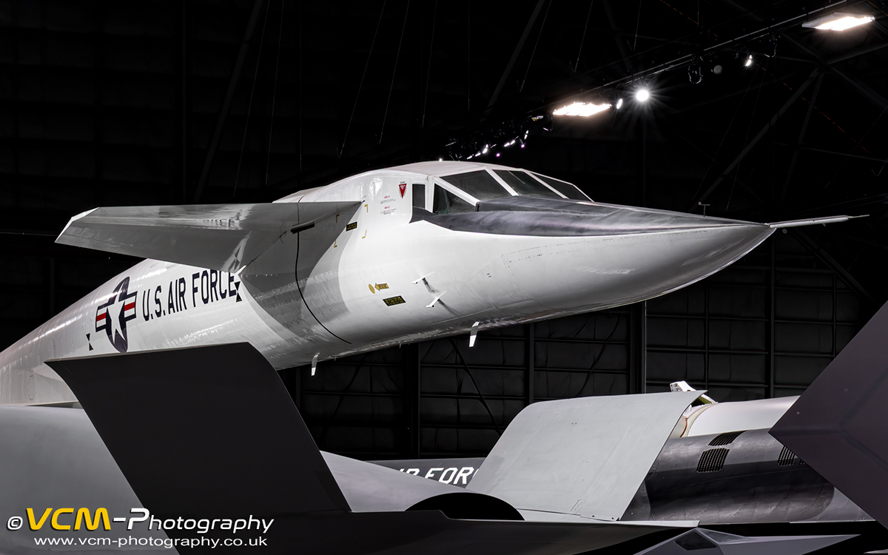 Like a Praying Mantis, the XB‑70A Valkyrie dominates the Research and Development Gallery.
Nestled alongside the Valkyrie under its port wing was the X‑15. Prior to our visit, I had seen
photos of the X‑15 displayed at the museum with its canopy in the open position, something I personally think detracts the
viewer from its sleek lines and image of speed. Thankfully, during our visit the canopy was in the closed position, which I think
made it more photogenic.
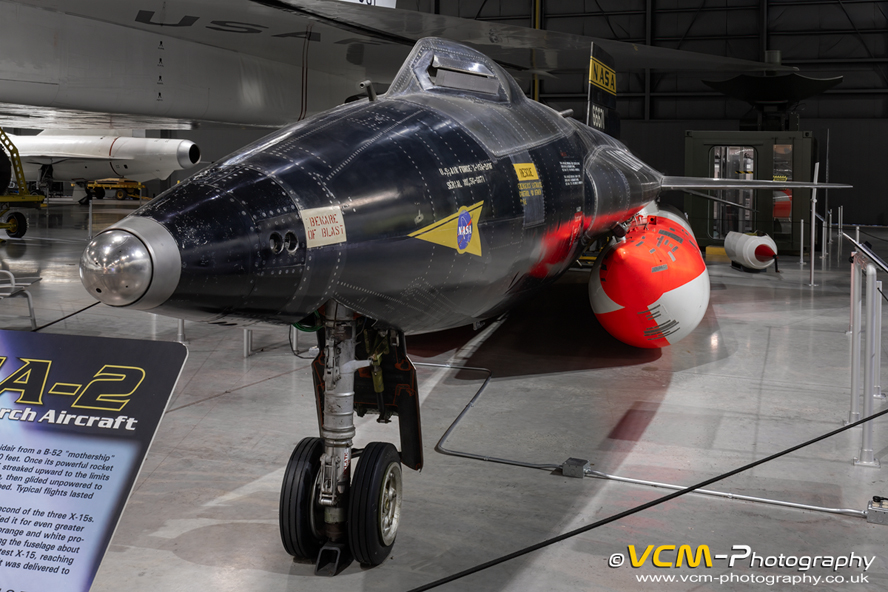 North American X‑15A‑2, S/N 56‑6671. This was the fastest X‑15, reaching Mach 6.7 in October 1967.
Other aircraft of note in the gallery were a Bell X‑1B, Convair XF‑92A, Douglas X‑3 Stiletto,
Lockheed YF‑12 and a Northrop/McDonnell Douglas YF‑23A Black Widow II.
Over the two days I managed to successfully visit all the galleries and take photos of all the aircraft. Overall, I was very impressed
with the museum, and though it is off the ususal tourist routes I think it was well worth the effort to visit it. I would
thoroughly recommend a visit by anyone who is interested in aircraft.
Our trip was now back on track with our planned itinerary and our return journey to the U.K. went without a hitch. To finish on
a positive note, British Airways compensated us for the delays on our outbound journey and my holiday insurance compensated us for the
cost of the new internal flights and car hire.